

PayerPrice Alternative
Gigasheet combines national healthcare price transparency data, Provider Rate Scores, intelligent provider search, and an autonomous AI Agent with a high-performance analytical engine built for questions that extend beyond contract benchmarking.
Analyze the data directly, assign the investigation to Gigasheet's in-app AI Agent, or connect your own applications and AI tools through the API and MCP.
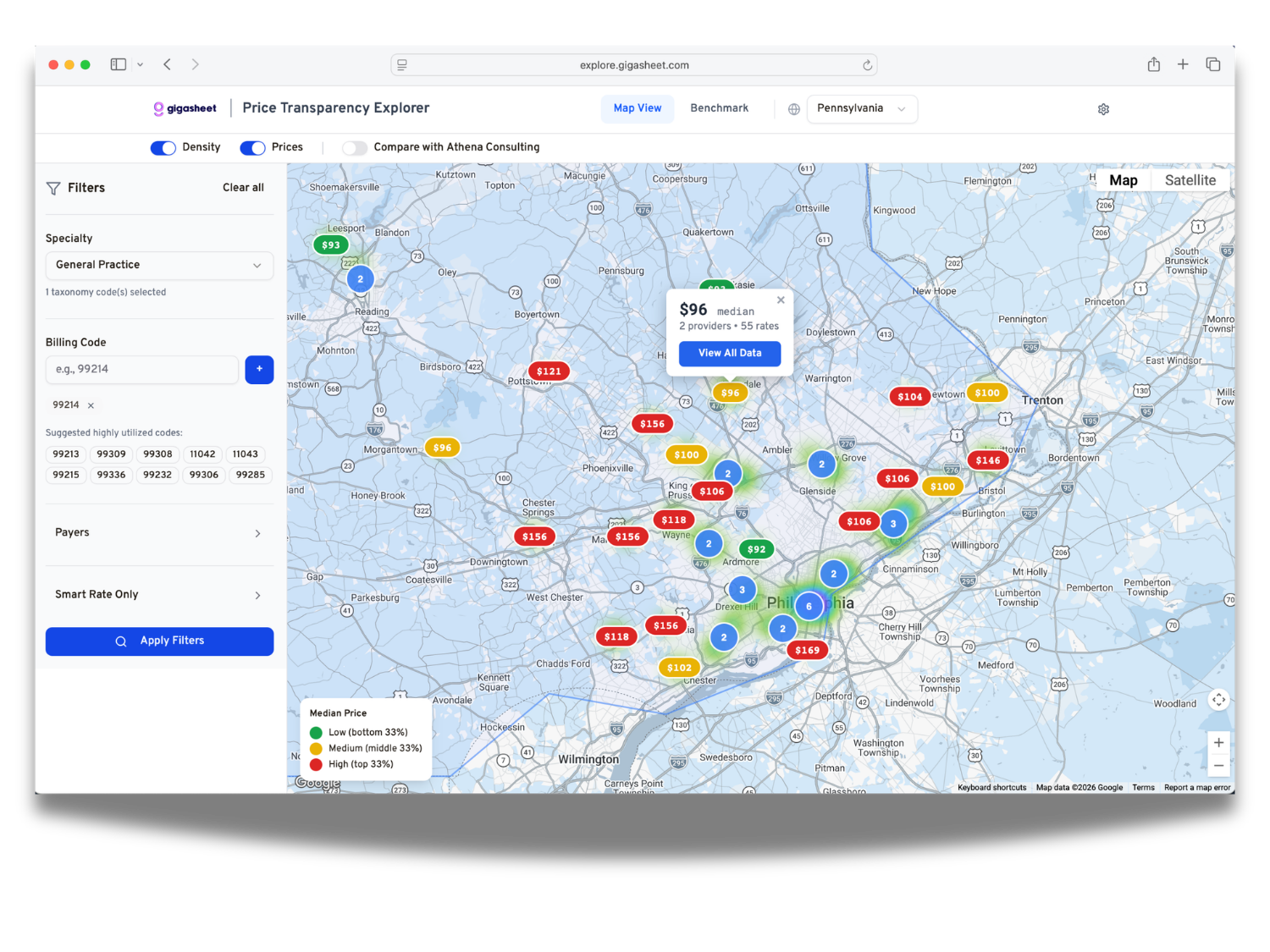


Go From Finding a Rate to Understanding the Market
PayerPrice is purpose-built for provider reimbursement analysis. It helps contracting, finance, and revenue integrity teams retrieve fee schedules, compare commercial rates, benchmark against Medicare, identify outliers, and support payer negotiations.
Gigasheet supports those analyses, but it is built for a broader range of healthcare market questions. You can investigate providers, payers, plans, procedures, specialties, networks, and geographic markets through a flexible analytical interface, assign complex research to an in-app AI Agent, connect external AI tools through MCP, run calculations through the API, or go straight to the underlying records.
The difference is not whether both platforms can find a negotiated rate. It is how far the platform can take the investigation after the rate is found.
Intelligence, Not Just Data
Gigasheet includes a native AI Agent inside the Price Transparency Explorer. Give the Agent a market objective and it works the problem on its own: finding the relevant providers, selecting the right rate data, building comparison groups, applying Smart Rate methodology, benchmarking against Medicare and local markets, investigating anomalies, producing charts and tables, and delivering a complete written report.
Compare orthopedic reimbursement across the largest provider organizations in Northern Virginia. Identify below-market payer relationships, benchmark the results against Medicare and local peers, and prepare an executive contracting report.
That is one prompt, not a workflow. You can work with the Agent through in-app chat, and Gigasheet also provides MCP access so external AI platforms such as ChatGPT and Claude can reach the same data and engine. PayerPrice connects AI agents to reimbursement data through its own MCP server. The Gigasheet difference is combining MCP with a native in-app Agent that conducts sustained analysis and writes the report.
Bring Your Own MRF
Most price transparency platforms center analysis on files already processed into their managed database. PayerPrice primarily centers its product on its managed national dataset. Gigasheet additionally supports direct and on-demand processing of customer-selected files.
Upload hospital MRFs yourself, or request processing of payer files including self-funded plan MRFs. That gives your team newly published, customer-specific, or previously unsupported files without waiting for the next standard processing cycle. Gigasheet handles JSON, CSV, and compressed files at healthcare scale.
Work with the latest data on your timeline, not ours.
Keep Working After the Benchmark Appears
PayerPrice offers useful reimbursement benchmarks, fee schedules, maps, pivots, dot plots, histograms, historical trends, and market comparisons. The Gigasheet distinction is what you can do next.
- Regroup results by payer, provider, plan, procedure, specialty, or market
- Create custom formulas and calculated fields
- Join transparency data with your own claims, contracts, and provider rosters
- Transform text, dates, and classifications
- Build new cohorts and scoring models
- Repivot the analysis as new patterns emerge
- Inspect the original supporting records behind any number
- Hand the next stage of the work to the AI Agent
Use the benchmark as the beginning of the analysis, not the final output.
Find the Right Provider and Understand Its Market Position
Provider identities are inconsistent across payer files, public records, practices, facilities, corporate entities, and locations. Gigasheet's AI provider search understands how providers are actually named and referenced in the real world, resolving misspelled names, abbreviations, incomplete organization names, multiple locations, related practices and facilities, individual versus organizational records, and ambiguous natural-language queries. PayerPrice offers structured lookup by NPI, Tax ID, specialty, payer, network, and geography.
Provider Rate Scores
Once the right provider is identified, Provider Rate Scores show whether its negotiated rates sit high or low within the relevant procedure, payer or plan, specialty, geography, and local peer market. Teams use them for care navigation, provider directories, network development, healthcare marketplaces, benefits analysis, provider recruiting, contract strategy, and market access planning.
Provider Rate Scores measure negotiated-rate market position. They do not measure clinical quality, estimate patient responsibility, or represent what a provider charges a patient directly.
Find the right provider. Understand its position. See the rates behind the score.
An API That Computes, Not Just Delivers
PayerPrice provides a capable API for retrieving provider relationships, negotiated rates, fee schedules, Medicare benchmarks, and market percentiles, along with MCP and direct data delivery to platforms such as Snowflake and Databricks.
The Gigasheet API can also run the analysis inside the platform. Applications can retrieve negotiated rates, group records, calculate averages, medians, modes, and distributions, apply formulas and conditional logic, run grouped aggregations, apply Smart Rate methodology, compare against Medicare, retrieve market benchmarks, and return the supporting records. You send a question or a set of parameters, Gigasheet runs the computation against its own infrastructure, and you get the answer back without first moving and maintaining the full national dataset.
Use the interface, assign the work to the Agent, call the API, or connect your own AI through MCP.
Which Platform Is Right for You?
Both platforms provide strong access to commercial negotiated-rate data. The right choice depends on how far past the benchmark your work goes.
Choose Gigasheet when you need
- A native in-app AI Agent and complete AI-generated market reports
- MCP access for external agents
- Customer-selected MRF processing, including hospital uploads and self-funded plan files
- Intelligent provider search and nationwide Provider Rate Scores
- Open-ended formulas, joins, pivots, and transformations
- An API that performs calculations, not just retrieval
- Proprietary and public data in one environment
- Use cases spanning providers, payers, benefits, care navigation, health tech, and medtech
PayerPrice may be the stronger fit when you need
- A provider-focused reimbursement and contracting platform
- Commercial fee schedules and contract benchmarking
- Market percentiles and Medicare-normalized comparisons
- Underpayment and revenue integrity workflows
- Historical rate alerts and claims context
- Structured API endpoints with SQL or warehouse delivery
Other PayerPrice Alternatives
PayerPrice is not the only platform in this category, and the right shortlist depends on what you are solving for.
Turquoise Health tracks negotiated rates across payer and provider transparency data and offers its own relativity index alongside percent-of-cohort analysis. Serif Health focuses on aggregating and normalizing transparency data, with an emphasis on data quality across a fragmented landscape. Clarify Health pairs price transparency with a national claims asset, provider performance measurement, and referral intelligence, and is aimed largely at large health systems. H1, formerly Ribbon Health, approaches cost through provider data and care navigation. Trilliant Health extends past pricing into broader market analytics and strategic planning.
Frequently asked questions
Is Gigasheet an alternative to PayerPrice?
Yes. Both platforms provide commercial negotiated-rate data, reimbursement benchmarks, Medicare comparisons, APIs, MCP access, and analytical tools. Gigasheet suits organizations that also need a native AI Agent, open-ended analytics, Provider Rate Scores, customer-selected MRF processing, or use cases beyond provider contracting.
What is the main difference between Gigasheet and PayerPrice?
PayerPrice is primarily focused on provider reimbursement, contracting, revenue integrity, and fee-schedule analysis. Gigasheet is a broader healthcare market intelligence platform serving providers, payers, benefits organizations, care navigation platforms, health tech companies, and medtech and life sciences teams.
Can Gigasheet analyze an MRF that is not already in its database?
Yes. You can upload hospital MRFs directly or request processing of payer files, including self-funded plan MRFs. Gigasheet supports JSON, CSV, and compressed files at scale.
Do both platforms offer MCP?
Yes. Both provide MCP access for compatible AI tools and agents. PayerPrice exposes structured rates and benchmarks through MCP. Gigasheet connects external agents to its healthcare data and its analytical engine.
Does Gigasheet also have an in-app AI Agent?
Yes. The Gigasheet Agent is available through in-app chat and can independently conduct multi-step analysis and produce a complete report. MCP is offered in addition to it, not instead of it.
Does PayerPrice support flexible analytics?
Yes. PayerPrice offers pivots, maps, dot plots, histograms, fee-schedule downloads, rate trends, claims integration, and market benchmarking. The Gigasheet distinction is a broader general-purpose analytical environment, custom file processing, direct formulas and joins, Provider Rate Scores, and the native autonomous Agent.
Can Gigasheet combine our data with price transparency data?
Yes. Claims, contracts, provider rosters, plan information, and utilization data can be joined with national price transparency data in the same analytical environment.
Comparison based on publicly available product information reviewed August 21, 2026. Features, data coverage, availability, and positioning may change. PayerPrice is a trademark of its respective owner and is not affiliated with or endorsed by Gigasheet.
Drive Growth with Market Intelligence

Assign the Analysis, Not Just the Lookup
A native AI Agent inside the platform takes a market objective, finds the providers, builds the comparisons, benchmarks against Medicare and local peers, and delivers a complete report. MCP connects your own AI tools to the same engine.

Bring Your Own MRF
Upload hospital MRFs directly, or have us process payer and self-funded plan files on demand. Analyze the files your organization actually needs, even when they are not already in the national dataset. JSON, CSV, and compressed files, at whatever size they arrive.

Provider Rate Scores
Nationwide scores showing whether a provider's negotiated rates sit high or low for the relevant procedure, payer, specialty, and local market. Built for care navigation, network development, benefits analysis, and contract strategy.


