

The Rates Are Public. The Answers Aren't.
What Is Price Transparency Data?
Price transparency data is the set of negotiated rates that health plans and hospitals must publish under federal rules. Payers publish Transparency in Coverage files. Hospitals publish their own standard charge files. Together they show what each payer has agreed to pay each provider for each billing code.
The raw files are massive, inconsistent, and full of rates that will never be billed. That is where most teams get stuck. Learn how the data works.
Clean Rates. Traceable Sources.
Gigasheet ingests payer and hospital machine-readable files nationwide, then cleans, structures, and enriches them. You get rates you can defend in a negotiation.


Know the Provider Behind the Rate
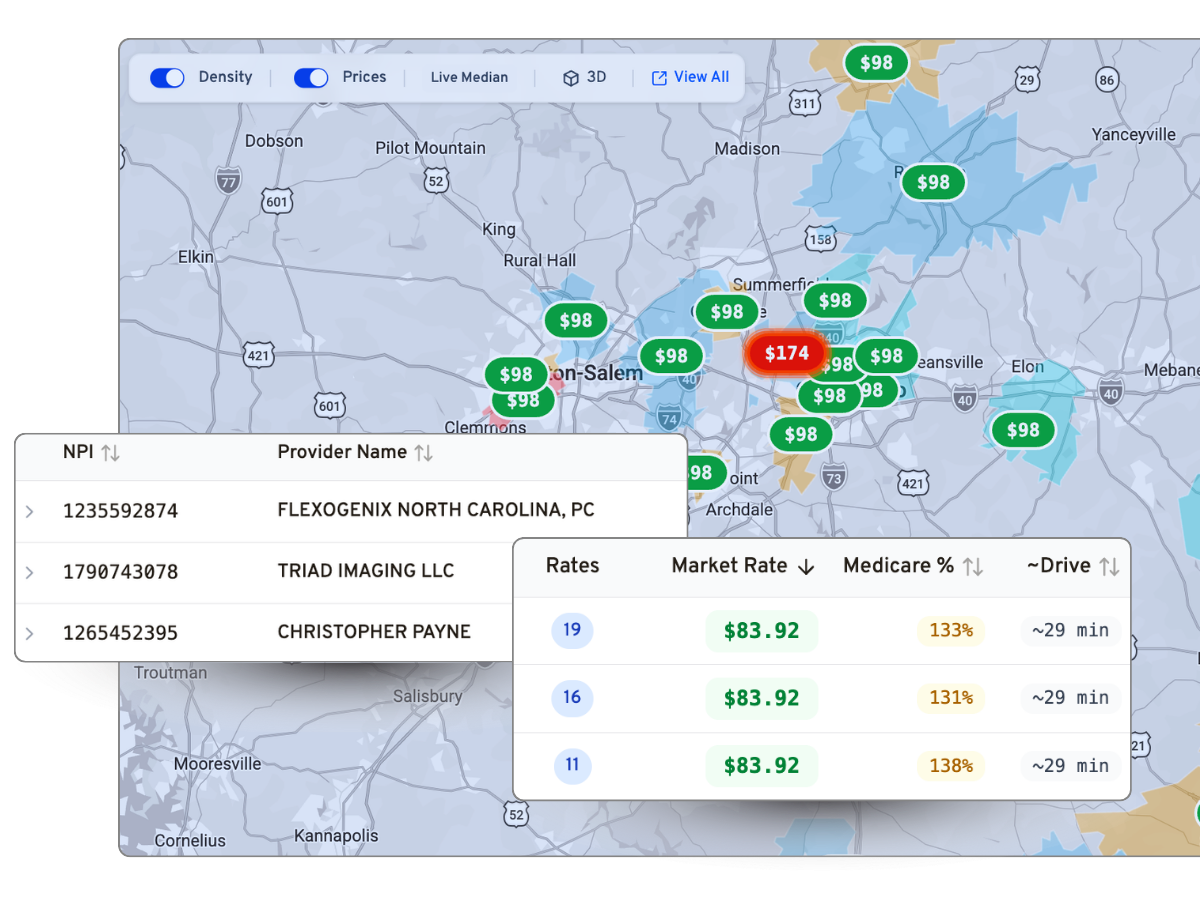
A rate means more when you know who is behind it. Gigasheet connects each negotiated rate to the provider, the plan, and the market.
Provider Rate Scores
A proprietary benchmark for how a provider's negotiated rates compare to market, in five bands from Bottom of Market to Top of Market. Scores measure negotiated-rate position only, not clinical quality or patient cost.
Market Benchmarks
Median negotiated rates by geography, specialty, and procedure, alongside geographically adjusted Medicare rates.
Provider Intelligence
A profile for each clinician: identity and practice details, verified contact and location data, online reputation, and regulatory standing drawn from public state and federal regulatory records that flag known disciplinary actions, exclusions, or revocations.
Network Intelligence
Published payer and plan associations behind each rate, for network development, adequacy research, and directory validation.
Get the Data Your Way
Price Transparency Explorer
Search and compare negotiated rates by provider, payer, and code nationwide.
Bulk Data
License full datasets: rates, provider resolution, and provider contacts.
Analytics API
Run custom rate calculations on Gigasheet infrastructure and get answers in seconds.
AI Agent
Ask in plain language and get an intelligence report with the backing data.
Working with a single file? MRF Viewer opens machine-readable files that break other tools.
Built for the Negotiating Table
“I would have never found this provider if it weren't for Gigasheet. That was the first one where I was like, this is actually going to make an impact in my day-to-day.”
Ben Yurk
Network Development Executive
HOMELINK, a division of VGM Group


Enterprise-Grade Security
Gigasheet is SOC 2 Type II compliant and meets or exceeds industry standards for data security.
Price Transparency Data FAQs
What is price transparency data?
Price transparency data is the set of payer-provider negotiated rates that insurers and hospitals publish under federal regulations. The rates are released in machine-readable files. Once cleaned and structured, they let teams compare contracted rates across providers, payers, and services.
What should I look for in a price transparency data provider?
Look for four things: coverage, cleaning, traceability, and context. Coverage means payer and hospital rates nationwide. Cleaning means errors and unusable rates are removed. Traceability means every figure ties back to its source file. Context means benchmarks and provider detail that turn a rate into a decision. Gigasheet delivers all four across 150B+ negotiated rates.
What tools can I use to view and analyze price transparency data?
Gigasheet offers a tool for each job. Price Transparency Explorer searches and compares rates by provider, payer, and code. MRF Viewer opens individual machine-readable files from payers or hospitals. The Analytics API and AI Agent answer custom questions against the full dataset.
Is price transparency data available as a data feed or API?
Yes. Gigasheet licenses price transparency data as bulk datasets, and through an Analytics API that runs rate calculations on Gigasheet infrastructure. Both are refreshed on an ongoing cycle as payers and hospitals republish their files.
How accurate is price transparency data?
Raw price transparency data reflects what payers and hospitals publish, including errors, outliers, and rates for services a provider will never bill. Gigasheet removes those before analysis and keeps every remaining figure traceable to its source file. Read the full accuracy breakdown.
What is Provider Intelligence, and how does it relate to rate data?
Provider Intelligence is a profile of the clinician behind each rate. It combines identity and practice details, online reputation, regulatory standing, and published network associations with negotiated-rate position. It supports network and market research. It is not a substitute for credentialing, and Rate Scores do not measure clinical quality.
What billing codes does the data cover?
The data covers every billing code that payers and providers publish, including CPT, HCPCS, and DRG codes. Teams compare negotiated rates across payers, benchmark against Medicare, and analyze variation by geography or provider type.
Healthcare price intelligence


