The CMS CY 2026 OPPS final rule introduces sweeping hospital price transparency requirements including actual allowed amounts, NPI disclosure, and stricter enforcement. Learn what these changes mean for healthcare pricing data.
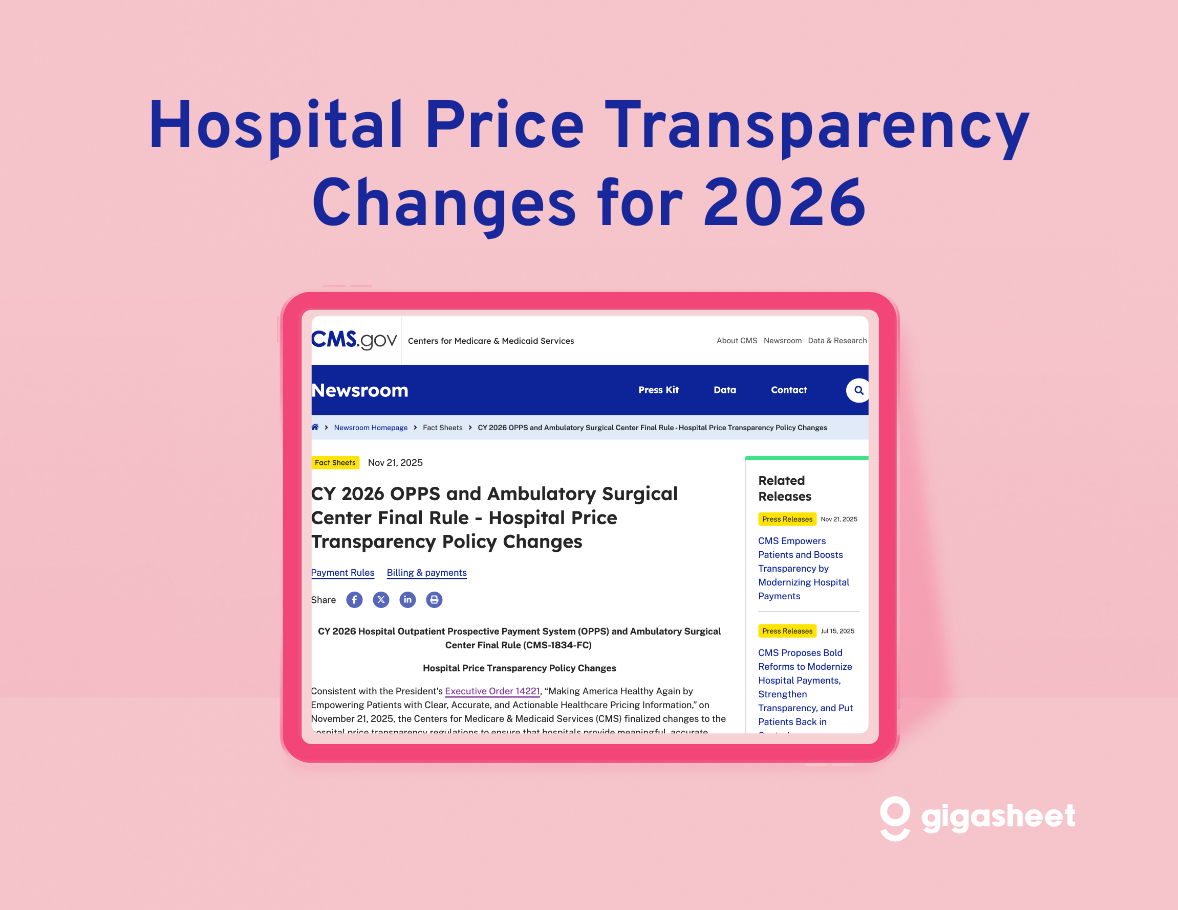
On November 21, 2025, the Centers for Medicare & Medicaid Services (CMS) released its Calendar Year 2026 Hospital Outpatient Prospective Payment System (OPPS) and Ambulatory Surgical Center final rule, introducing the most significant updates to hospital price transparency requirements since the original regulations took effect. These changes fundamentally reshape how hospitals must report pricing data in their machine-readable files (MRFs), creating unprecedented opportunities for healthcare organizations to access actionable pricing intelligence.
The final rule directly responds to Executive Order 14221, "Making America Healthy Again by Empowering Patients with Clear, Accurate, and Actionable Healthcare Pricing Information," and represents CMS's commitment to ensuring patients and healthcare stakeholders have meaningful, comparable pricing data.
The End of Estimated Allowed Amounts: Real Dollar Figures Required
The most consequential change in the final rule is the elimination of "estimated allowed amounts" in favor of actual dollar figures derived from real claims data. Under the new requirements, hospitals must now disclose three specific data points for each payer and service combination:
Median Allowed Amount: The middle value of all allowed amounts for a given service and payer combination, providing a reliable central benchmark for actual reimbursement rates.
10th Percentile Allowed Amount: The lower bound of typical reimbursement, helping identify the floor of what payers actually pay for services.
90th Percentile Allowed Amount: The upper bound of typical reimbursement, revealing the ceiling of negotiated rates.
Count of Allowed Amounts: The number of claims used to calculate these figures, providing context for statistical reliability.
This shift from estimates to actual allowed amounts transforms the utility of price transparency data. Healthcare organizations can now access real reimbursement intelligence rather than theoretical calculations, enabling more accurate competitive analysis and contract benchmarking.
EDI 835 Remittance Data: The Gold Standard for Pricing
CMS now requires hospitals to use Electronic Data Interchange (EDI) 835 electronic remittance advice or equivalent remittance data sources to calculate and encode the median, 10th percentile, and 90th percentile allowed amounts. This mandate ensures that reported figures reflect actual payment transactions rather than contract language or fee schedule estimates.
The lookback period for calculating these amounts must be no less than 12 months and no longer than 15 months prior to posting the MRF. This standardization creates consistency across the industry while ensuring data remains current and relevant.
When calculated values fall between two observed allowed amounts, hospitals must use the next highest observed value, ensuring conservative and defensible reporting.
National Provider Identifiers Now Required in MRFs
To enhance data comparability and linkage across healthcare datasets, CMS now requires hospitals to include their organizational (Type 2) National Provider Identifiers (NPIs) in their machine-readable files. Specifically, hospitals must report any Type 2 NPI associated with a primary taxonomy code starting with "28" (hospital) or "27" (hospital unit) that is active as of the most recent update date.
This requirement enables healthcare organizations to cross-reference price transparency data with other datasets such as Medicare cost reports, claims data, and provider directories. For competitive intelligence and market analysis, NPI linkage unlocks powerful analytical capabilities that were previously difficult to achieve.
Enhanced Attestation and Accountability
The final rule strengthens accountability through new attestation requirements. Hospitals must now certify in their MRF that:
All applicable standard charge information has been included in accordance with regulatory requirements.
The encoded information is true, accurate, and complete as of the file date.
All payer-specific negotiated charges expressible as dollar amounts have been included.
For charges based on percentages, algorithms, or formulas, all necessary information for calculating dollar amounts has been provided.
Critically, hospitals must now encode the name of the hospital CEO, president, or senior official designated to oversee data accuracy in the MRF. This executive accountability provision signals CMS's intent to hold leadership responsible for compliance.
Civil Monetary Penalties: Incentives for Resolution
CMS introduced a new provision allowing hospitals to reduce civil monetary penalties (CMPs) by 35% if they waive their right to an Administrative Law Judge (ALJ) hearing. This incentive encourages faster resolution of compliance issues and acceptance of CMS's determinations.
However, this reduction is not available for violations of core requirements, specifically: failing to make public an MRF as required, or failing to make shoppable services available in a consumer-friendly format. These exclusions underscore CMS's prioritization of fundamental transparency obligations.
Implementation Timeline
January 1, 2026: New requirements become effective, including median/percentile allowed amounts, attestation requirements, and NPI disclosure mandates.
April 1, 2026: Enforcement of new provisions begins. CMS is providing this three-month grace period to allow hospitals time to update systems, validate data, and post compliant files.
Preparing for Compliance: Validating Your MRF Files
With enforcement beginning April 1, 2026, hospitals should begin preparing now to ensure their machine-readable files meet the new requirements. CMS provides a free online validation tool that allows hospitals and other stakeholders to check MRF files for compliance with the updated schema and data requirements.
The CMS Hospital Price Transparency Online Validator enables hospitals to upload their MRF files and receive immediate feedback on formatting errors, missing required fields, and schema compliance issues. This tool is invaluable for identifying problems before files go live and before CMS enforcement actions occur.
We recommend hospitals validate their files well in advance of the April deadline, allowing time to address any technical issues with data extraction, encoding, or file formatting. Payers, employers, and analytics vendors can also use this tool to understand what compliant data should look like and identify potential quality issues in the files they consume.
The Good and the Gaps: A Balanced Assessment
We welcome these regulatory changes as a meaningful step forward for healthcare price transparency. The shift to actual allowed amounts and the addition of percentile distributions represent real progress. However, significant gaps remain that limit the utility of this data for patients and healthcare decision-makers alike.
What We Like About These Changes
Real dollar amounts replace estimates. The requirement for median and percentile allowed amounts derived from actual EDI 835 remittance data is a game-changer. This transforms MRFs from theoretical pricing documents into actual market intelligence.
Statistical context improves utility. The 10th and 90th percentile figures, along with claim counts, provide crucial context about rate variation and data reliability. A median rate based on 500 claims tells a very different story than one based on 5 claims.
NPI requirements enable data linkage. Mandating organizational NPIs in MRFs allows analysts to connect price transparency data with other healthcare datasets, unlocking more sophisticated market analysis.
Executive accountability raises the stakes. Requiring hospital leadership names in attestations signals that data accuracy is a C-suite responsibility, not just a compliance checkbox.
Standardized lookback periods improve comparability. The 12-15 month requirement ensures hospitals report data from similar timeframes, making cross-hospital comparisons more meaningful.
What Still Needs Work
Payer and plan name standardization remains absent. The same insurance company appears in MRFs as "Blue Cross Blue Shield," "BCBS," "Blue Cross BS," "Anthem BCBS," and dozens of other variations. Without standardized payer identifiers, comparing rates across hospitals requires extensive manual data cleaning.
Plan naming conventions vary wildly. Plan names like "Gold PPO," "PPO Gold," "Employer Group PPO," and "Commercial PPO" may or may not represent comparable products. Patients and analysts cannot easily determine which plans are equivalent across hospitals.
Billing code standardization is incomplete. While CPT and HCPCS codes provide some consistency, hospitals vary in how they report revenue codes, modifier usage, and bundled service definitions. The lack of uniform code-level requirements makes apples-to-apples comparisons difficult.
Service descriptions lack consistency. The same procedure code might be described as "MRI Brain w/o Contrast," "MRI HEAD WO," or "BRAIN MRI NO DYE" across different hospitals, creating confusion for patients trying to shop for services.
Patient usability remains an afterthought. Despite the goal of empowering patients, these files remain fundamentally designed for technical consumption. A patient searching for knee replacement costs still cannot easily find and compare their options without sophisticated analytical tools or intermediaries.
These gaps represent opportunities for future rulemaking. We encourage CMS to consider mandatory payer and plan identifiers (perhaps leveraging existing NAIC codes or CMS plan IDs), standardized service description taxonomies, and clearer guidance on billing code reporting. Until then, platforms like Gigasheet play a critical role in normalizing and making sense of this fragmented data.
What This Means for Healthcare Organizations
For Providers
These changes create both compliance obligations and strategic opportunities. The requirement for actual allowed amounts means hospitals must implement robust systems for extracting and analyzing remittance data. However, the same data that drives compliance also enables better understanding of competitive positioning and payer relationships.
For Payers
Enhanced price transparency data enables more sophisticated network analysis and rate benchmarking. The median and percentile figures provide insight into how hospital reimbursement varies across markets and service lines, supporting network strategy and contract negotiations.
For Self-Funded Employers
Access to actual allowed amounts transforms cost containment strategies. Employers can now identify high-value providers, benchmark their plan's rates against market norms, and make data-driven decisions about center of excellence programs and reference-based pricing.
For MedTech Companies
Device and pharmaceutical manufacturers gain unprecedented visibility into procedure-level reimbursement across markets. This intelligence supports pricing strategy, market access planning, and health economics research.
Turning Compliance Data into Competitive Intelligence
The 2026 price transparency requirements generate massive volumes of detailed pricing data. However, raw MRF files remain notoriously difficult to work with. Files can exceed hundreds of gigabytes, contain millions of rows, and require specialized technical expertise to process and analyze.
This is where Gigasheet transforms the landscape. Our platform processes and normalizes machine-readable files from across the country, making this valuable pricing intelligence accessible through an intuitive spreadsheet interface. Healthcare organizations can filter, sort, and analyze pricing data without writing code or managing complex databases.
With the addition of median, 10th percentile, and 90th percentile allowed amounts in 2026, the analytical possibilities expand dramatically. Gigasheet enables users to:
- Benchmark negotiated rates against market medians and percentile distributions
- Identify rate variation across payers and service lines
- Support contract negotiations with actual market data
- Track competitive positioning over time
- Generate reports for leadership and board presentations
Preparing for April 2026
The CY 2026 OPPS final rule represents the most significant enhancement to hospital price transparency since the original regulations took effect. For healthcare organizations seeking to leverage this data for competitive advantage, now is the time to establish analytical capabilities and baseline market intelligence.
Gigasheet is ready to help you make sense of the enhanced price transparency data coming in 2026. Our platform already processes billions of rates from hospital MRFs nationwide, and we are preparing for the expanded data elements this rule requires.
Ready to transform price transparency data into actionable intelligence? Schedule a demo to see how Gigasheet can help your organization leverage hospital pricing data for strategic advantage.
Resources:
CMS CY 2026 OPPS and Ambulatory Surgical Center Final Rule
CMS Hospital Transparency Resources
Hospital MRF Validator Tool
Healthcare price intelligence

.png)