


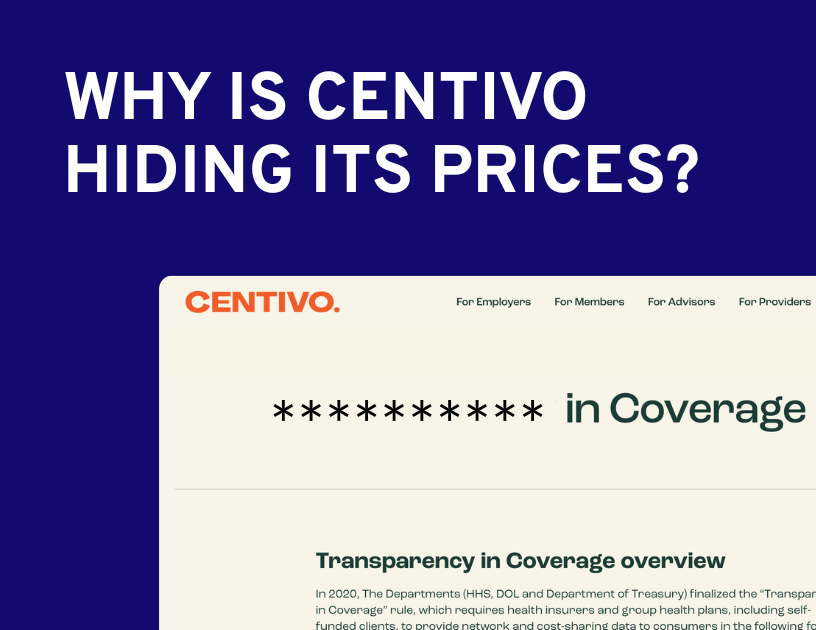
[Update, July 28, 2026: Centivo responded and attributes the broken links, unparseable files, and masked identifiers to a legacy platform vendor they say they stopped using, in part because of problems with its output, and states that a new MRF platform has produced proper files for clients since January 2026. Centivo shared an example link from the new platform, and those files are valid and unmasked. The legacy files documented below have since been taken offline. Centivo states there was no deliberate effort to obscure prices, and we credit them for engaging.
Some questions remain open. The files we found containing identifiers masked with asterisks were dated June 1, 2026: five months after the legacy system was reportedly retired, and four years after the federal rules went into effect.
Regardless, we are pleased to see Centivo is now posting usable transparency data that will help self-funded employers, benefits partners, and ultimately employees make informed decisions about their healthcare.
Our original findings follow, unchanged except where noted.]
Recently a client requested we analyze Centivo's published machine-readable files (MRFs), the public rate files every health plan is required to post under federal price transparency rules, for a self-funded employer plan. What we found is eye-opening. Based on everything we can observe, it's a deliberate effort to obscure their prices and a direct violation of federal regulations. [Update 7/28: It's hard to imagine the masking being anything other than deliberate; Centivo attributes it to a legacy vendor's system rather than a Centivo decision. See note above.]
Who Is Centivo?
First, some context. Most people assume their employer buys insurance from a carrier (like Blue Cross, United, Cigna, or Aetna), the same way families buy homeowners or auto insurance. In reality, most large employers pay for their employees' health services directly out of their own funds, hiring a third-party administrator (TPA) to run the plan. Per KFF, 67% of all covered workers, and 80% at large firms, are in self-funded plans. So when a self-funded plan overpays for care, that's not an insurance company's money. It's the employer's money, and by extension the employees' wages and, for public entities, taxpayer dollars.
Centivo is one of those TPAs: a venture-backed health plan founded in 2017, built for self-funded employers and marketed as a lower-cost alternative to traditional carriers. Its model centers on primary care-anchored networks, no-deductible plan designs, and claims of major savings versus BUCA plans (honestly, it sounds pretty great). It has raised well over $200 million from investors including Morgan Health (JPMorgan) and Bain Capital Ventures. Which is exactly why the gap between the transparency marketing and the lack of transparency reality is impossible to overlook.
What is Transparency in Coverage
Since July 2022, federal Transparency in Coverage rules require every health plan to publish its negotiated prices in MRFs. Over the years CMS has provided updated guidance and the data has become increasingly useful for comparing provider prices, plans, and understanding market dynamics. Each plan is required to post a table of contents file (the index) that links to the actual rate files. The rate files list every negotiated price alongside two identifiers that tell you which providers that price applies to: the NPI, a public ID number every provider in America has, and the TIN, the tax ID of the practice or hospital.
Index leads to files. Files contain prices. Identifiers connect prices to providers. Centivo fails all three. [Update: this has since been remediated as of July 28, 2026]
What We Found
The index is broken. Centivo publishes the required index file, but the links inside it don't work. They're malformed, and even after correcting the obvious errors by hand, the files they point to don't exist. Anyone starting where the regulation says to start hits a wall of error pages.
The files are malformed. Centivo's hosting portal also has direct links to the rate files themselves. After downloading it's clearly malformed data: the file fails basic parsing, or in plain terms, "machines" can't read it.
The provider identifiers are redacted. After working around these first 2 hurdles and opening a file we see the section that's supposed to tell you which providers each rate applies to. Here's what we find:
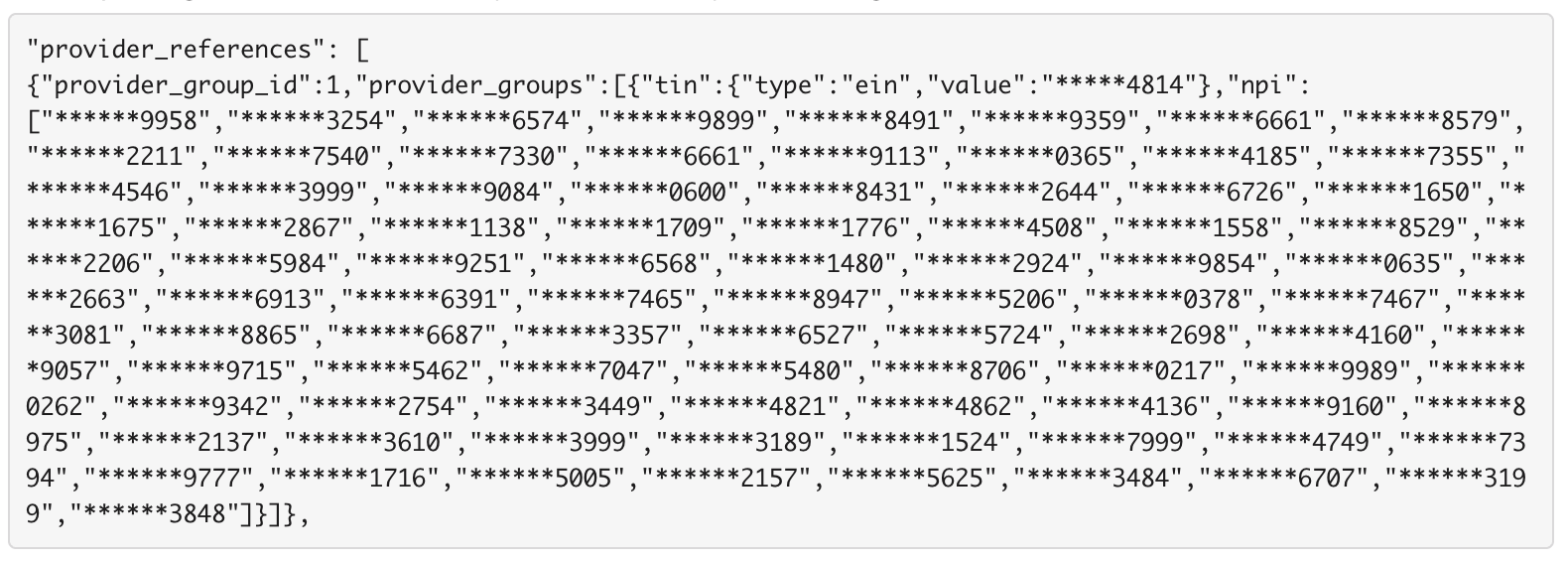
Every provider ID. Every tax ID. Masked with asterisks, like a censored credit card number. This goes beyond an IT bug; this information was deliberately redacted, whoever built the system that did it.
NPIs are public information, like a business address. You can look up any provider's NPI in thirty seconds on the government's own registry. There is no privacy, security, or technical justification for hiding them, and we'd welcome one if Centivo has it. We reached out to Centivo for an explanation and have not heard back. [Update 7/28: Centivo has since responded. See update at the top.] What we can say with confidence is that nobody blacks out identifiers by accident.
By stripping the identifiers, they have produced a list of prices attached to redacted providers. The data is technically "published" and functionally useless. Centivo postures themselves as transparent and compliant, and in practice hides their actual prices.
A Pattern of Price Obfuscation
Perhaps one of these issues, in isolation, could be an honest mistake. MRF pipelines are genuinely hard, and we've seen plenty of good-faith errors from payers who fix them when notified. That's not what this is.
We're not the first to notice this. Centivo's NPI masking was publicly flagged by others in the industry back in April 2025, raising the obvious question: why produce an MRF at all if you're going to redact the public identifiers and render the file useless?
That was more than a year ago. The June 2026 files we pulled are still masked, and now the index is broken and the files won't parse on top of it. This isn't a bug; it's a tactic. [Update 7/28: Centivo attributes this to its former vendor. Regardless, intentionally masked files were published for over a year after being publicly flagged.]
The Hypocrisy
When reading Centivo's own Transparency in Coverage page, everything appears to be in order. It presents price transparency compliance as something Centivo handles on behalf of its self-insured plan sponsors, while noting that plan sponsors bear ultimate responsibility under the regulations. Their CEO has gone so far as to blog about this stating "Let me be clear, we at Centivo are not 'anti-transparency'. In fact, radical transparency is at the foundation of our health plan." Notice, though, what he means by transparency: clients seeing their fees and members seeing their copays. Not the public rate data the federal regulations actually require.
This is a company that has raised over $200 million and runs claims for some of the largest self-funded employers in the country. Publishing working links and readable files is not beyond their engineering capabilities. And make no mistake about where these files stand: blacked-out identifiers and unreadable files don't satisfy the letter of the mandate, let alone the spirit. These files were non-compliant; it’s as simple as that.
A TPA that built its entire brand on being the affordable, transparent alternative to the big carriers is publishing some of the least usable transparency data we've seen from any payer, large or small. [Update 7/28: since remediated, see above]
Why Hide The Data?
We can't read minds, so let's follow the incentives. Ask yourself who benefits when negotiated rates can't be matched to providers.
Not the employer. Not the employees. Not the providers. The only party that benefits from un-benchmarkable rates is the party whose rates might not survive benchmarking. If your network discounts are as strong as your marketing says, transparent data is free advertising. You'd want everyone comparing. Masking your data is the behavior of a company that either doesn't know what's in its own contracts or doesn't want its clients or competitors to find out.
Back in 2021 Centivo contributed to the FUD around price transparency, and while we could argue about how useful this data truly is for consumers, the fact is in 2026 employers, consultants, and benefits advisors use price transparency data to see what plans are actually paying. That helps them guide members to high-value care, and it fosters competition, because the market can finally see who negotiates competitive rates and who doesn't. If anything, Centivo's model makes this data more important for its clients, not less. Their members enjoy predictable copays, which means the employer is the one absorbing the actual prices behind the scenes, out of its own bank account, with a fiduciary duty to know whether "predictable for the member" also means "competitive for the plan."
Regardless, payers and plans don't get to pick and choose which federal regulations they comply with. The policy debate happened. The government and the American public want more transparency. The rule has been in effect since 2022, and every major carrier manages to publish usable files, and Centivo should not be an exception.
The Fiduciary Problem
This is where it stops being a niche industry gripe and starts becoming a real legal risk.
Under the Consolidated Appropriations Act and ERISA, self-funded plan sponsors are fiduciaries. They have a legal duty to prudently manage plan assets, which means understanding what the plan actually pays for care. The Johnson & Johnson and Wells Fargo lawsuits make the stakes explicit: "my TPA handled it" is not a defense. Plan sponsors are being sued by their own employees for failing to monitor exactly this kind of thing.
Centivo's clients are self-funded employers, including public entities spending taxpayer dollars, who chose Centivo specifically because it promised affordability and transparency. Those clients are now carrying compliance exposure they almost certainly don't know they have, on files published in their name, with penalties under TiC that can run up to $100 per member per day.
And the employees lose twice. They can't verify what their plan pays. And their employer, the fiduciary legally obligated to verify it for them, can't either.
To be clear: none of this is on the plan sponsor, i.e. the employer. A county government or a mid-market employer relies entirely on its TPA to produce these files. They don't have MRF engineering teams. That trust is precisely what's being abused here. The sponsor's name is on files it has no ability to audit, published in a broken structure that hides provider details.
What Self-Funded Employers Can Do
If you're a self-funded employer, on Centivo or anyone else, do this today:
- Find your machine-readable files. Your TPA is required to tell you where they're posted.
- Actually try to open them. Download a file, unzip it, open it in a free tool like Dadroit or upload in a free Gigasheet account. If it gives an error or fails to parse, or has asterisks where identifiers should be, you have a problem.
- Put the question to your TPA in writing. As a fiduciary, you want a paper trail showing you asked.
- Get an independent read on your data. This is what we do all day at Gigasheet and plenty of others in the industry are capable of this as well. A competent partner can tell you in plain terms whether your files are usable and how your rates actually stack up.
Transparency isn't publishing bogus files. It's publishing data the industry can use. Anything less is theater, and the audience is federal regulators, plaintiff's attorneys, and increasingly, your own employees.
Healthcare price intelligence

.png)


